

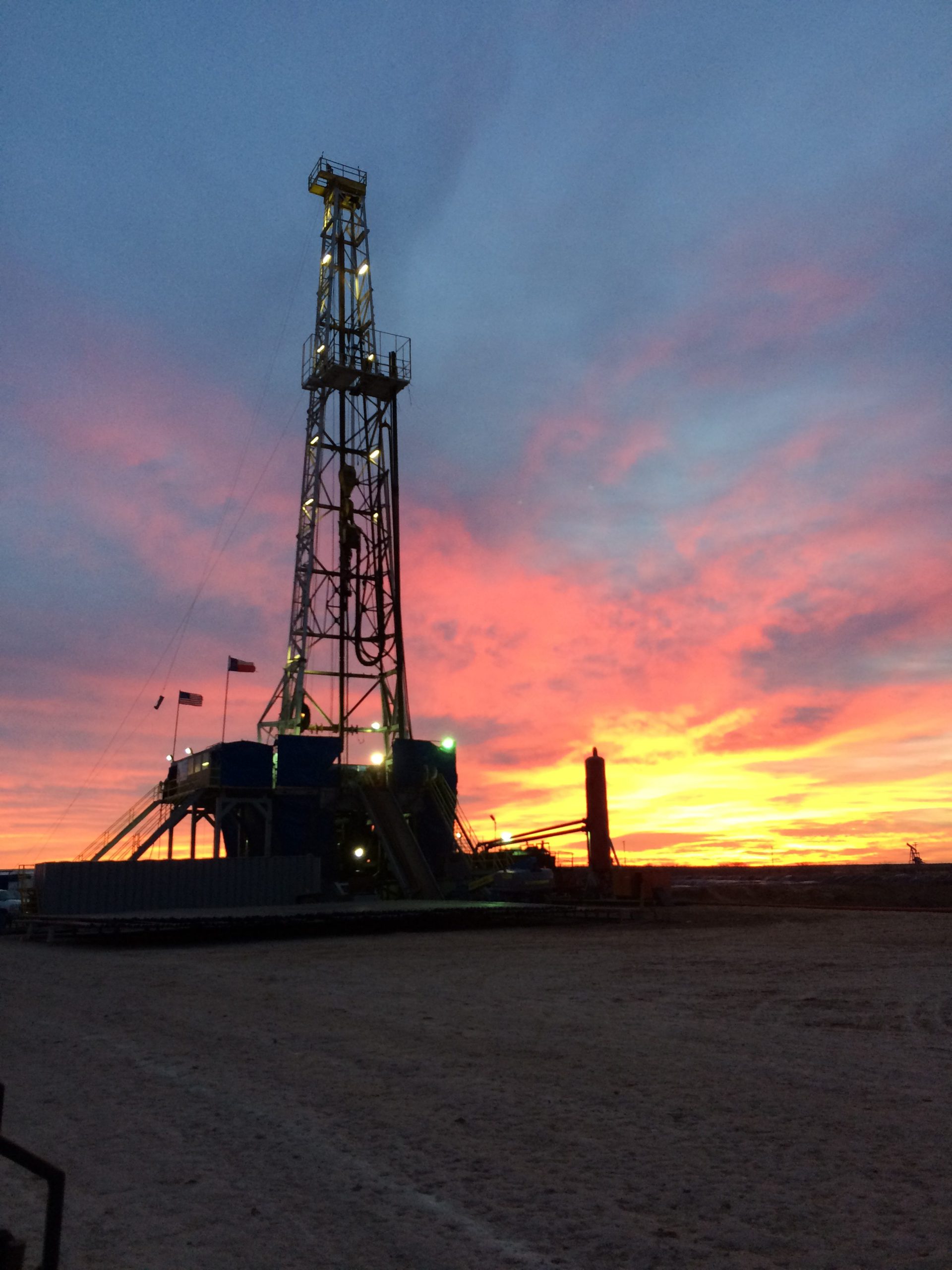
Two Mudloggers, Different Perspectives
At first glance, mudlogging appears objective.
Gas curves, cuttings descriptions, rate of penetration, and background trends feed the same mudlogging systems and the same screens for everyone at the wellsite.
But two mudloggers can look at the same well and reach different conclusions.
The difference isn’t the data, it’s the interpretation behind it.
So why does one mudlogger confidently call a formation top while another hesitates?
Why does one flag a subtle gas show as formation-related while another dismisses it as noise?
The answer is simple, and uncomfortable for a highly automated industry:
Mudlogging is not just data collection. It’s geological interpretation in real time.
The Myth of “Same Data, Same Answer”
In theory, two mudloggers watching the same well should reach the same conclusions.
In practice, they rarely do.
That’s because mudlogging data at the wellsite is:
- Noisy
- Incomplete
- Affected by drilling parameters
- Influenced by mud properties, lag, and operational changes
The instruments may be identical, but mudlogging interpretation never is.
This is why formation top identification while drilling remains as much an interpretive skill as a technical one.
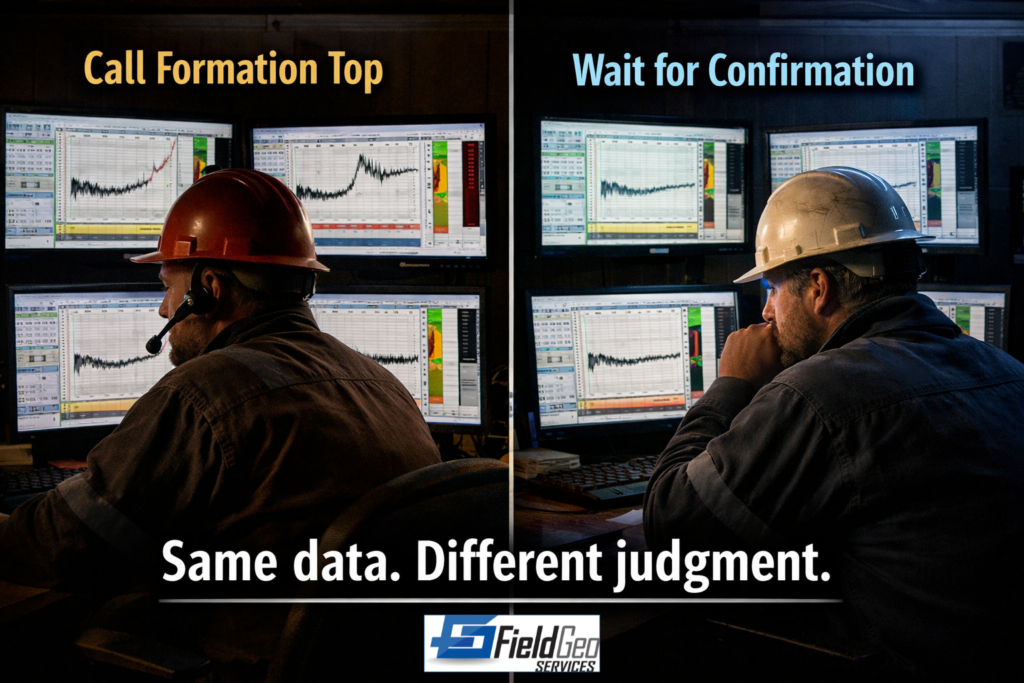
Experience Turns Mudlogging Data Into Geological Context
An experienced mudlogger doesn’t just see a gas spike, they interpret it in context:
- Is this connection gas or formation gas?
- Does it match the lithology change in the cuttings?
- Does it align with offset well behavior?
- Is the ROP change operational or geological?
Less experienced loggers often interpret signals in isolation.
Seasoned mudloggers interpret patterns across multiple drilling signals.
That pattern recognition only comes from having seen:
- False gas shows that looked real
- Real shows that looked insignificant
- Formation tops that didn’t announce themselves cleanly
This is the difference between mudlogging experience and raw data exposure.
Pattern Recognition Beats Raw Sensitivity
Modern mudlogging systems provide extremely sensitive, high-resolution drilling data.
That’s both a blessing and a risk.
More sensitivity means:
- More signal
- More noise
- More temptation to over-interpret
Experienced mudloggers recognize familiar geological signatures:
- Gas character that ramps versus snaps
- Cuttings changes that lag versus lead
- Trends that build versus flicker
They know when not to call a formation top, which is often just as important as calling it early.
This is where geological judgment in drilling interpretation outweighs instrumentation alone.
Judgment Is the Invisible Variable in Mudlogging
Judgment appears in decisions that rarely make it into the final mudlogging report:
- Whether to wake the geologist or company representative
- Whether to flag a change immediately or wait for confirmation
- How strongly to phrase a geological recommendation
- When uncertainty should be communicated, and when confidence matters
These are real-time wellsite geology decisions, often made under pressure and without a rulebook.
That level of interpretation cannot be automated by software or sensors.
The Cost of Misinterpreting Formation Tops
A misinterpreted drilling signal or missed formation top can lead to:
- Late geosteering corrections
- Missed landing zones
- Overconfidence in poor reservoir rock
- Hesitation when decisive action is needed
The financial impact of a single incorrect formation top pick can exceed the cost difference between mudlogging providers many times over.
This is why mudlogging expertise and accuracy matter operationally, not academically.
Data-Rich Doesn’t Mean Judgment-Free
The industry has never had more real-time drilling data at the wellsite.
But more data does not reduce the need for experience, it increases it.
Without strong interpretation:
- Good geological data gets ignored
- Poor-quality signals get trusted
- Subtle reservoir indicators get buried
The difference between two mudloggers isn’t what they see.
It’s what they recognize in the data.
The Quiet Advantage of Experienced Mudloggers
The best mudloggers rarely draw attention to themselves.
They simply make fewer mistakes.
They call formation tops earlier, or withhold calls longer, for reasons grounded in experience.
They don’t just react to screens; they anticipate geological changes ahead of the bit.
That’s the difference between logging a well and understanding it while drilling.
Where Field Geo Services Fits
At Field Geo Services, we don’t assume that data alone leads to good drilling decisions.
Our mudloggers are selected and trained with the understanding that interpretation, not instrumentation, is the true differentiator in mudlogging services.
We emphasize:
- Degreed geologists
- Mudlogger experience
- Geological pattern recognition
- Clear wellsite communication
- Formation evaluation while drilling
Because these are the factors that consistently reduce subsurface uncertainty and improve well placement outcomes.
In a data-rich drilling environment, FGS focuses on what still matters most:
Putting informed geological judgment behind every formation top call.
Need mudlogging you can trust when decisions matter? Field Geo Services combines experienced mudloggers with interpretation-focused workflows to improve formation top confidence and reduce drilling uncertainty. Contact FGS to learn how we support better wellsite decisions.
